

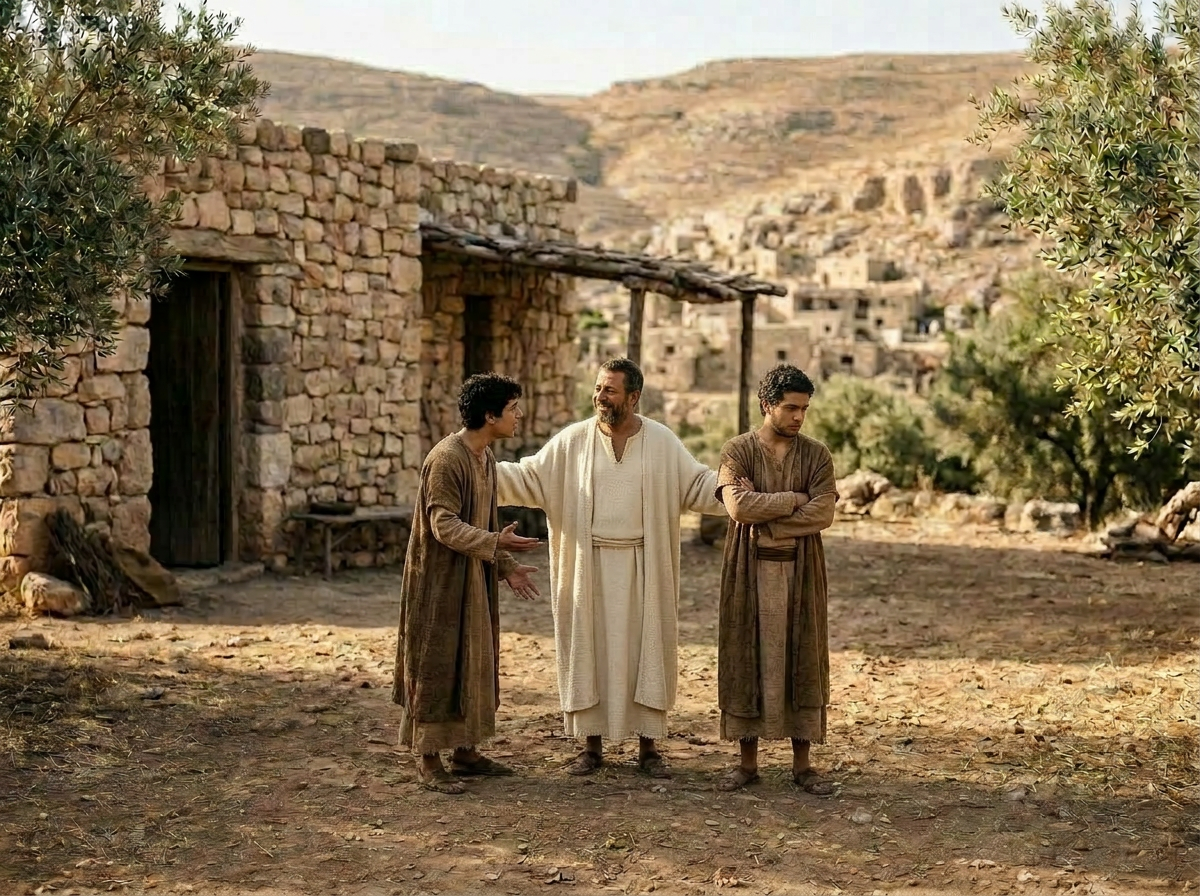
We have certainly all read the parable of the “Prodigal Son.” This parable teaches us about the lost son who returned to his Father, and that aspect is true and precious. However, this parable is not only about the lost son; it also speaks of the elder son, but above all it reveals another equally important aspect (I would even say a more important one): the Father’s love for both of his sons.
The parable, then, is about a Father and two sons. The younger is called lost. The elder is not described as such, but his attitude reveals an inner distance. One could therefore say that he too was lost, but in a different way.
“And he said: A certain man had two sons.” Loukas (Luke) 15:11
The Father goes out for the younger son, lost in the world. He also goes out for the elder son, outside in service, far from His heart. The younger son was physically and spiritually far from the Father. The elder son, although he was with the Father, was spiritually far from His heart.
There are sometimes in the Father’s house these two categories of sons: some lost in the world, drawn by the love of the world, and others lost in work without grasping the Father’s love.
So there are those who return to their vomit, living like pagans, and those who remain frustrated far from the Father’s house. These two forms of estrangement are rooted in a failure to know the Father’s heart.
The younger son: lost in the world
“And the younger of them said to his father: Father, give me the portion of goods falling to me. And he divided to them his livelihood. And not many days after, the younger son, having gathered all together, went abroad into a far country, and there dissipated his substance, living in debauchery” Loukas (Luke) 15:12-13
After he had wasted everything and found himself in need, he decided to return, knowing his Father’s generosity. He thought he would receive more kindness if he came back as a simple servant.
This reasoning reveals a knowledge of the Father’s goodness, but not a true relationship with Him. Thinking of returning as a servant, while he had always been a son, revealed a distorted view of the Father.
He knew the Father the way servants might know him, but he lacked an intimate and relational knowledge of Him. His return was not primarily motivated by love for the Father, but by the suffering he experienced outside. By asking for his inheritance while his Father was still alive, he had chosen a life far from Him, unaware that the world that attracted him had nothing to offer him.
The Elder Son: Lost in Service
As for the elder son, although he had remained physically with the Father, he was not aware of his place. His reaction to his brother’s return reveals the state of his heart.
His frustration at the treatment given to the younger brother, and the language he uses, reveal that he saw himself more as a servant than as a son, suggesting that his service was based on a logic of merit rather than on relationship.
“But he was angry, and would not go in. Therefore his father having come out, entreated him. But answering, he said to the father: Behold, so many years I have been slaving for you, and never at any time passed by your commandment, and never did you give me a young goat that I might make merry with my friends. But when this son of yours came, the one having devoured your living with prostitutes, you killed for him the fatted calf!!” Loukas (Luke) 15:28-30
The elder son had not gone back into the world; he was serving the Father but had lost the revelation of His heart. This category of people may come to do things to attract the Father’s attention: they sacrifice themselves, work hard, and initiate things. They act not out of relationship, but out of a desire to demonstrate their value or their merit.
“Now his elder son was in the field. And coming, as he drew near to the house, he heard music and dancing.” Loukas (Luke) 15:25
Here, the field can symbolize the place of work or even one’s deeds. We see a serious son, serving the Father with devotion, yet without an awareness of his position. When we become frustrated at seeing others succeed in life, it reveals that we have not yet fully grasped the Father’s love for us or our true identity. This jealousy is a sign of insecurity.
The elder son, instead of entering and sharing in his Father’s joy, focuses on his own lack. He misses a moment of celebration. Sometimes heaven is rejoicing, and we remain in sadness. To know the Father’s heart is to feel what He feels.
Identity Before Service
It was said of Yeshua: “This is My beloved Son,” not after His public ministry, but before the beginning of it. We do not become sons by serving; we serve because we are sons. It is because the Father receives us and accepts us that He associates us with His work. Our service is an act of obedience born out of this grace.
To serve without first knowing one’s identity is to be exposed to bitterness, comparison, and many similar things.
Today, we see a scarcity of sons and daughters of the Kingdom who rise up to defend the Father’s interests, not for dishonest gain, but because they love the Father and know that the Father loves them. It is rare to see sons and daughters who act out of relationship rather than social pressure or the pursuit of outward recognition.
The Father’s Love
The Father went out to meet his younger son who was returning from his misadventures. He also went out to meet his son who was coming back from the field. The younger son had a heart full of remorse, the elder a heart full of anger. Yet each time, the Father went out.
The younger son had offended the Father, but the Father’s love went before him. As soon as he sees him from afar, he runs to meet him without reproach. The Father is eager to be with his children; He prepares a feast! Hallelujah!
This parable teaches us that one can have an appearance of sanctification while still harboring a bitter heart toward the Father, sometimes because of misunderstandings or a sense of injustice. We see others receive things that we do not have, and we begin to wonder why the Lord gives to others and not to us, even though we pray.
We forget our identity, and we forget what the Father has already given us, and we begin comparing ourselves with others.
This account highlights the love of the Father, the One who comes out to meet His children. The elder son no longer wanted to enter the house because he had begun to consider the Father unjust, based on how he saw his brother being treated. The Father’s love for his brother had made him forget the Father’s love for him.
How often hearts turn away from the grace of being His children and become bitter because of what is happening around them.
The good news is that every time, the Father comes out, and even then, the Father extends His hand to bring His children back home.
Let us remember, finally, that this parable was also given to teach the Pharisees and the scribes, who did not understand why the Lord welcomed people who had lived sinful lives. The Pharisees had the Torah, yet they did not know His heart. They judged others according to outward appearances, while their own hearts were full of greed.
For them, the lost were the tax collectors; they forgot that they themselves, though defenders of the Torah, were also lost. They ignored the love the Father has for His sheep. They could not understand that the Father would go out to look for the lost sheep.
Knowing the Father’s heart is essential in order to remain in the house, and to return to it if we have wandered away.
“For I consider that the sufferings of this present time are not worthy with the glory which is about to be revealed for us.” Romans 8:18
Suffering and difficulties are not evidence of the Father’s absence or rejection. This truth is also evident in the life of Yeshua; even though He was the Son, He still went through suffering.
“Although being a Son, he learned obedience by the things which he suffered. ” Hebrews 5:8
The Call to Serve the Father as Sons
It is time to rise and serve—not as outsiders, but as sons. We may be disappointed by people to the point of no longer wanting to serve the Lord, or of doubting His calling. Yet, as sons and daughters of the Kingdom, we must realize that our place is not outside, but in the Father’s house. It is the Father who calls us!
We do not need to pretend to impress other believers, because this is a matter of our heart before the heart of the Father. His desire is to reveal Himself; He wants us to know the depths of His love. If He came down and sacrificed Himself, it was because He loved us.
Knowing the Father allows us to enter into our identity. For it is written: “But I say, the heir, as long as he is a child, differs nothing from a slave, though he be lord of all;” (Galatians 4:1) The word “child” here, in the Greek nēpios, also means someone who is ignorant.
The Father calls us to remain in the house and seek Him, for He desires to reveal Himself to His children.
“Then will we know, if we follow on to know YHWH: his going forth is prepared as the morning; and he will come to us as the rain, as the latter and former rain to the earth.” (Hoshea 6:3)
Peace and grace to your homes!
Y. Gerol

